Featured buildAI2026
ScreenSense
Visual attention prediction with a custom-trained CNN
- AUC-Judd
- 0.9613
- published 0.87
- Pearson CC
- 0.8756
- published 0.74
Full-stack AI application that predicts where human eyes will look first in any image. Trained a custom 6.6M-parameter MobileNetV2 + U-Net saliency model on a research dataset, deployed it as a containerised FastAPI service on HuggingFace Spaces, and shipped a polished Next.js frontend with real-time heatmap analysis.
Impact
Trained entirely on personal hardware and surpasses the published SALICON baseline on all 5 standard saliency metrics. Has direct applications in UX and product design, advertising and marketing, e-commerce conversion optimization, and accessibility testing.
- Python
- PyTorch
- MobileNetV2
- FastAPI
- HuggingFace Spaces
- Docker
- Next.js
- TypeScript
- Tailwind CSS
- Vercel
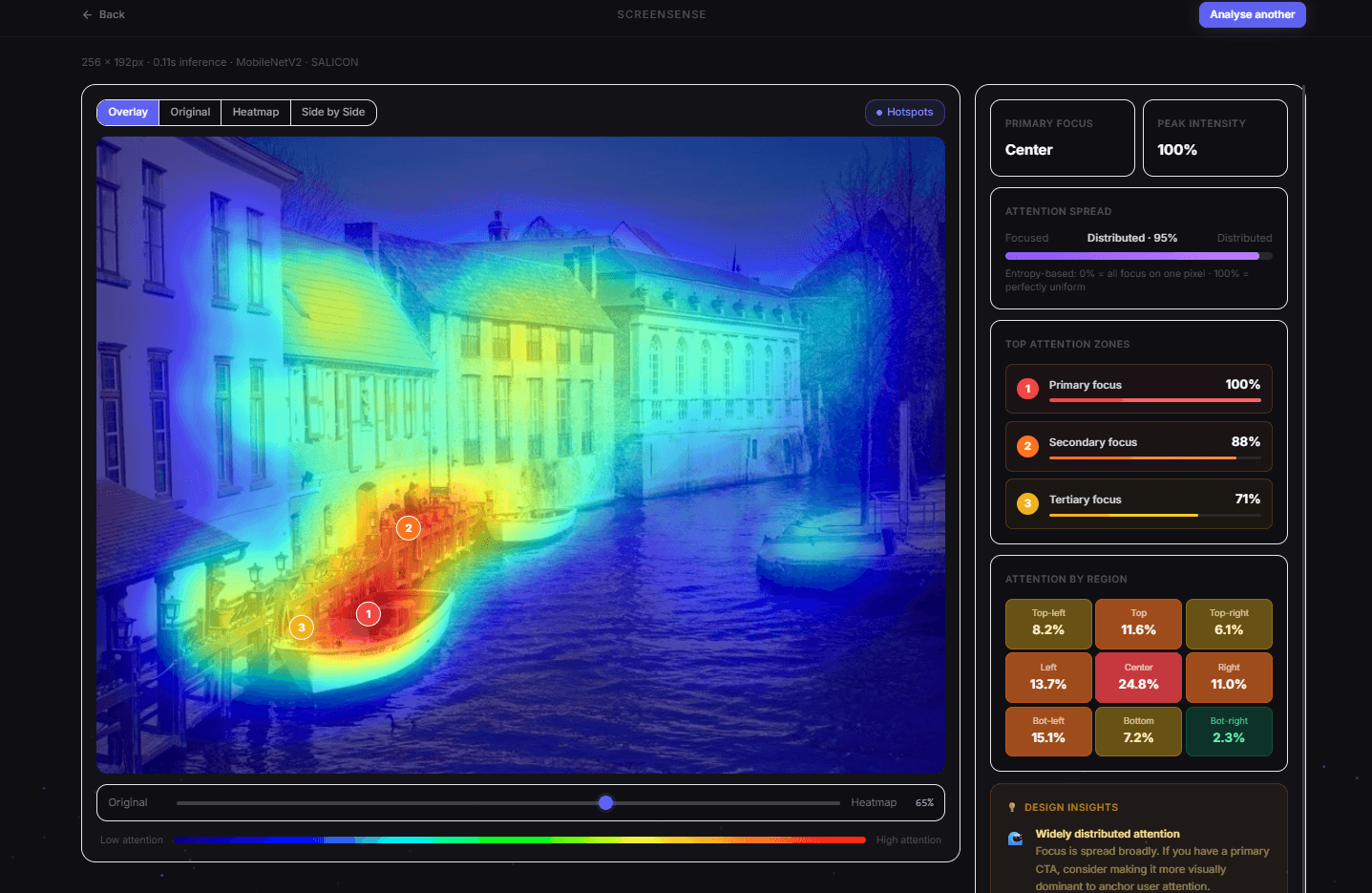
- Trained on SALICON, 10,000 training and 5,000 validation images annotated with crowd-sourced human fixation data collected via mouse-tracking as a proxy for eye-tracking, using a composite KL-divergence + Pearson CC + BCE loss, mixed-precision AMP, and a frozen encoder warmup strategy for the first 5 epochs.
- Built a custom post-processing pipeline on top of raw model output: peak suppression for ranked hotspot coordinates, Shannon entropy for an attention spread score, and a 3x3 region grid that drives rule-based design recommendations.
- Designed a results page with a three-mode segmented image viewer (original, heatmap, overlay), top-3 attention zone cards with gradient intensity bars, and contextual design tips tied directly to where attention lands on the uploaded image.